
St. James Parish Projected Release Meaning
The LDPSC telephone locator uses the exact label projected release date. It reflects the department's present sentence calculation when one is available. Official sentencing documents, time already served, statutory credit rules, forfeitures, program credit, court corrections, and other lawful factors can alter it. Always record the date on which the projection was obtained.
An actual release is the completed custody event. It has its own date, time, type, and sometimes a destination. Parole eligibility is the date or threshold at which a person may be considered under the applicable law. A favorable Board result is an authorization subject to conditions and processing. None of those items is interchangeable.
Note: Preserve the date of each projected-release result because a later official calculation may lawfully replace an earlier estimate.
Find St. James Parish Projected Release
Start by deciding whether the person is a parish pretrial detainee, a person serving a parish sentence, or an LDPSC-committed person. Louisiana uses local jail beds for some people in state legal custody, so a St. James physical location does not settle the question. Obtain the judgment or commitment information when the legal custodian is unclear.
- Search Louisiana LAVNS by full name and an available ID or case number. Compare the reporting agency and status date.
- For state custody, call the LDPSC Imprisoned Person Locator at 225-383-4580. Provide the DPS&C number, or the name plus date of birth.
- Ask for the custody placement, facility contact, projected release date if applicable, and assigned P&P district.
- For a local sentence, call the St. James Parish Detention Center at 225-562-2505 and obtain the court judgment from the St. James Clerk criminal division.
- If the calculation matters, obtain the Master Prison Record and the judgment. The state time-computation information line is 225-342-0799.
- Confirm the actual event later through LAVNS and the agency's release, discharge, or movement record.
The LDPSC inmate-information page documents the locator, its 24-hour system update description, and the projected-date telephone route:
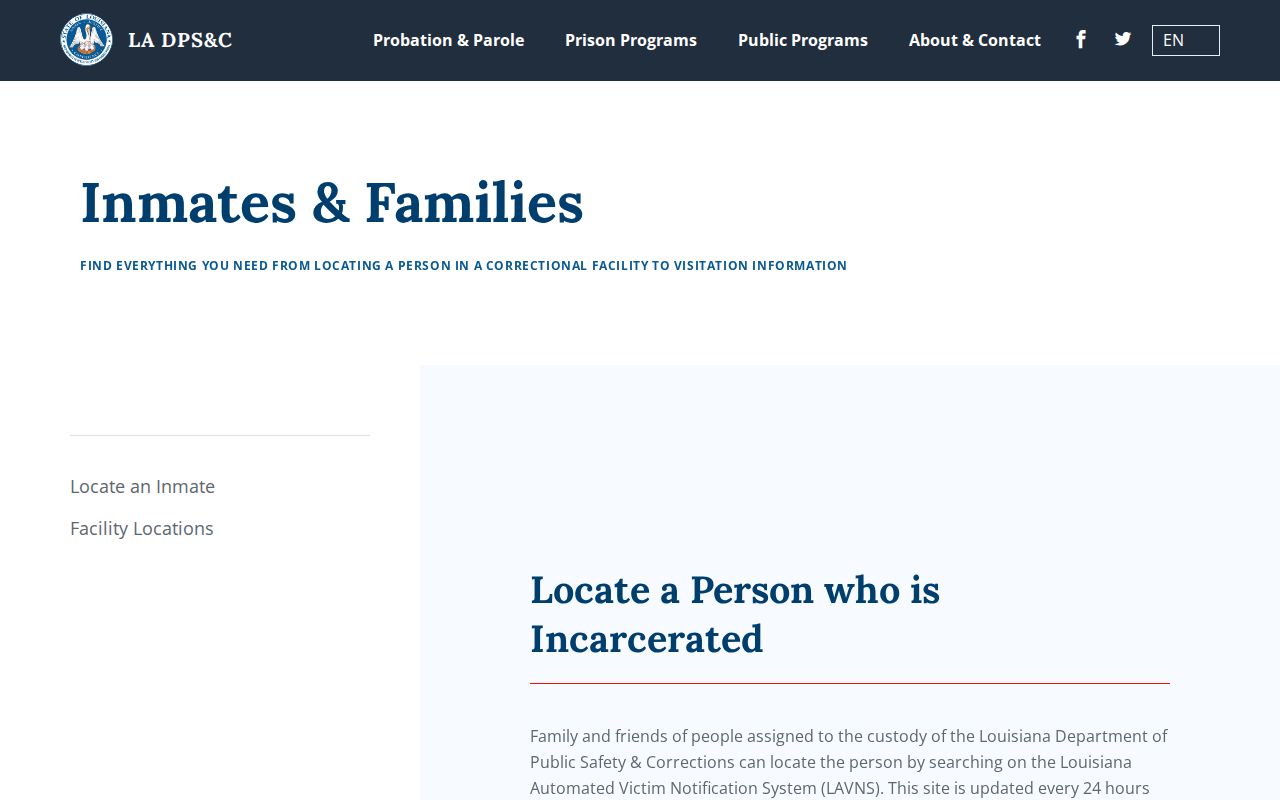
The screenshot supports the official access path. It does not display a live person's calculated date or guarantee that every case has one.
Note: The locator's projected date and the Master Prison Record serve different needs; request the record when the calculation itself is disputed.
St. James Parish Pretrial Release Dates
A person awaiting trial usually has no sentence-based projected release date. Release may follow bond, dismissal, a judge's order, or another lawful change. It can also be delayed by a separate warrant, detainer, or receiving agency. The sheriff's current roster does not publish a future release field, bond disposition, sentence end, or destination.
For a pretrial case, use the St. James Clerk criminal division to obtain the docket chronology, bond order, minute entry, dismissal, or other public disposition. Then ask the sheriff for the custody transaction. A court minute can explain the authority but may not record when jail processing ended. A jail transaction can record the movement while leaving the full case disposition to the court.
Electronic Bail Bonds are used at the Correctional Center, but the sheriff's general bond or fine information is not a case-specific order. Bond-out leaves the criminal case pending. It also does not rule out another hold. Confirm the actual terms with the docket and the resulting departure with the sheriff.
St. James Parish Release Offense Dates
Louisiana's key dividing date for the newer good-time framework is the offense date, not the booking, conviction, search, or future release date. For offenses committed on or after August 1, 2024, R.S. 15:571.3.1 generally allows an eligible felony offender in a parish prison or LDPSC custody to earn good time up to 15 percent of the particular sentence. That is the source of the common 85 percent shorthand.
The shorthand is not a universal rule. Sex-offense sentences and habitual-offender sentences are excluded from that 15 percent framework. No good time accrues on presentence credit under the cited rule. Credits may be forfeited, and qualifying program diminution under R.S. 15:828 may also matter. The LDPSC secretary controls the official determination. Split-sentence probation and revocation can add another status after physical release.
Older offenses use R.S. 15:571.3 and multiple rates. Parish sentences without hard labor can use a 30-days-per-30-actual structure, while a first crime of violence has a different 3-per-17 rate. Older LDPSC felony categories include other rates for ordinary eligibility, specified violent offenses, and certain repeat nonviolent cases. Exclusions and offense history still govern. Do not import the newer 15 percent cap into an older case.
Why St. James Parish 85% Varies
Release-date calculation in St. James Parish turns on legal details that a name search cannot supply. The offense date selects the statutory framework. The judgment identifies the conviction and sentence. The Master Prison Record reflects LDPSC's computation, including credited time and applicable diminution. Disciplinary forfeiture, eligible program credit, and a later court correction can then change the result.
The official post-August 2024 good-time law shows the maximum 15 percent structure and its limits:
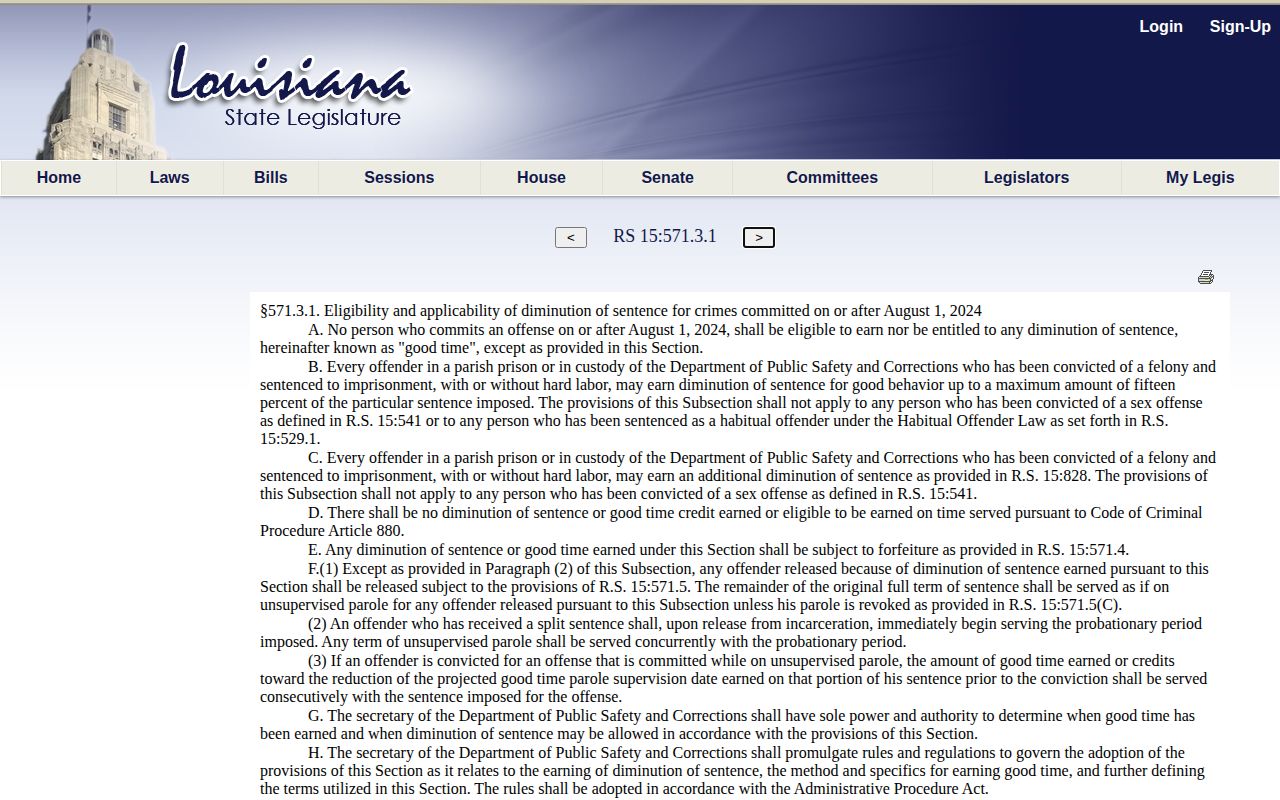
The statute is a framework for the official calculation. It is not a safe tool for hand-calculating one person's St. James Parish projected release date.
Changes to St. James Parish Release Dates
A projected date can move in either direction as the official record changes. Ask which factor was applied and request the dated computation record when accuracy matters.
| Factor | Possible effect | Record to check |
|---|---|---|
| Sentencing documents | A missing or corrected judgment can delay or revise calculation | Certified judgment, commitment, and Master Prison Record |
| Presentence credit | Qualifying time served may alter the custodial calculation | Court order and official time computation |
| Good-time eligibility | Applicable credit can reduce the custodial portion | Offense date, conviction, statute, and Master Prison Record |
| Forfeiture or discipline | Loss of earned credit can move the estimate later | LDPSC computation and relevant final record |
| Program credit | Qualifying credit may affect the date if officially awarded | LDPSC program and computation records |
| Detainer or warrant | Departure from one facility can become a transfer | Sheriff movement transaction and receiving-agency record |
| Court correction | An amended sentence or order can change the basis | New court order and revised computation |
| Parole action | Eligibility, grant, denial, or revocation can change the release path | Board docket/result plus actual custody event |
St. James Parish Parole Date Differences
Parole eligibility is separate from good time and the projected release date. Louisiana's pre-August 2024 parole structure includes different thresholds for qualifying ordinary nonviolent cases, first violent convictions, later violent convictions, sex offenses, and other histories, with many exceptions. Eligibility permits consideration. It does not guarantee a hearing result or physical release.
Search the Louisiana Board's dated agenda and result near the hearing week. A “granted” entry shows panel approval subject to the process and conditions. Confirm when those conditions were met and when the custodian processed departure. A denial, reconsideration, continuance, removal, or revocation should be reported with its exact date and label.
After community release, an assigned Donaldsonville P&P district can support a supervision status. It does not prove full discharge or the exact moment of exit. The St. James probation and parole page covers the local district and Board path without merging those records with the projected date.
Correct St. James Parish Release Calculations
If a state-facility resident disputes the calculation, the official route begins with the facility Records Office. A locally housed LDPSC person uses the applicable Administrative Remedy Process. A family member or researcher should request the relevant record and ask the responsible custodian to explain or correct it, not submit a personal formula as if it were an official sentence calculation.
Ask separately for the Master Prison Record or time-computation sheet, custody movement history, and actual release or discharge record. Provide the full name, DPS&C number, date of birth, parish or facility, and case details needed to identify the correct person. Keep each agency response and timestamp. If the judgment and state calculation disagree, obtain both and ask the official records office to reconcile them.
The record set should also preserve the offense date. A date taken only from booking or conviction can place the calculation under the wrong statutory framework. Note whether the sentence is a parish term, an LDPSC commitment, or a split sentence with probation to follow. Request the credit entries as recorded rather than converting them into an informal total. Presentence credit, diminution, and program credit have distinct legal bases. A clear request lets the records office answer from the actual computation instead of asking it to evaluate a guess.
If a correction is made, obtain the revised Master Prison Record or written response and record the effective date. Do not erase the earlier projection from the file. The change history explains why an alert, old docket, or family note may show a different date. When no revised record is produced, describe the dispute and the two dated sources without declaring that one unofficial calculation controls.
Confirm St. James Parish Actual Release
Near the projected date, search LAVNS again and register for a custody-event alert when offered. Then verify with the agency that holds the person. For St. James local custody, ask whether the departure was a community release or transfer and request the date, time, type, destination, and receiving agency. For LDPSC custody, seek the actual release or discharge status rather than relying on the old projection.
When sources conflict, check timestamps, identity, and custody layer. A St. James roster entry marked in custody may predate a later LAVNS movement. A court order may precede jail processing. A person may leave St. James and appear in LDPSC, BOP, or ICE. Preserve both dated records until the creating offices explain the sequence.
Notifications can help with timing, but they remain a separate function from sentence computation. The St. James VINELink inmate search explains the specific-person check, four-digit PIN, and state-notice distinction.
Note: A release alert supports a custody change, while the agency's actual release or movement record supplies the authoritative event details.